
Comparison
Best Rewardful Alternatives for SaaS in 2026 (5 Tools Compared)
Five honest Rewardful alternatives for SaaS on Stripe — Affitor, FirstPromoter, Tolt, Dub Partners, and PartnerStack: pricing verified July 2026, attribution trade-offs, and a straight answer on who should pick what.
Updated Jul 5, 2026
SaaS teams leave Rewardful for three reasons: revenue caps that force plan upgrades as you grow, cookie-based attribution that drops conversions, and a feature ceiling around commissions, reporting, and fraud. If none of those hurt yet, keep Rewardful. It has the simplest setup in the category for a Stripe SaaS, a true 0% transaction fee, and a REST API on every tier, including the $49 plan. Plenty of programs never need more.
This guide compares five alternatives worth shortlisting in 2026: Affitor, FirstPromoter, Tolt, Dub Partners, and PartnerStack. One disclosure before we start: we build Affitor. It is one of the five tools below, and this post tells you plainly where the others beat it.
Quick answer: what is the best Rewardful alternative for SaaS?
Affitor is the best Rewardful alternative for SaaS that wants to pay $0/month until affiliates generate their first $10,000 in revenue. Pick FirstPromoter if you bill outside Stripe and Paddle, Tolt if you want unlimited affiliates on a flat subscription, Dub Partners if developer experience decides your tooling, and PartnerStack if you run a multi-type partner program with an enterprise budget. Stay on Rewardful if its revenue caps and cookie attribution do not hurt you yet.
| Tool | Best for | From price (as of Jul 2026) | Transaction fee | Attribution |
|---|---|---|---|---|
| Affitor | Paying only on results | $0/mo | 3.5% on affiliate-driven sales after first $10K | Signup-anchored via Stripe metadata |
| FirstPromoter | Billing beyond Stripe and Paddle | $49/mo | None stated | Cookie, 60-day default |
| Tolt | Unlimited affiliates on a flat fee | $69/mo | 2% on automated payouts | Cookie, configurable window |
| Dub Partners | Developer-first teams | $90/mo | 5% payout fee (3% Enterprise) | Signup/lead-anchored |
| PartnerStack | Enterprise multi-type programs | From $1,000/mo (paid annually) | None published | Not publicly documented |
Every price on this page was checked against each vendor's live pricing page on July 5, 2026. Affiliate software pricing moves fast — two of these vendors materially changed their pricing pages in the three weeks before this was written — so treat the live pages as the source of truth.
Why teams outgrow Rewardful
Rewardful's model is a flat subscription with revenue-capped tiers. Per rewardful.com/pricing (as of July 5, 2026): Starter is $49/mo for up to $7,500/mo in affiliate-generated revenue, with 1 campaign and up to 2 team members. Growth is $99/mo for up to $15,000/mo, with unlimited campaigns and a branded affiliate portal. Enterprise starts at $149/mo above that. There is no free tier. The 0% transaction fee is genuine: the subscription is all you pay.
The caps are the first thing that bites. A program doing well crosses $7,500/mo in affiliate revenue and the tool's price doubles, not because you used more software but because your affiliates performed. Cross $15,000/mo and it steps again.
The second issue is attribution. Rewardful tracks with cookies (first-touch or last-touch, selectable, with a 60-day default window). When the cookie is gone (cleared, blocked, expired, or the buyer switches devices), the referral is gone with it, and the affiliate who earned the sale does not get paid.
The third is the feature ceiling, and it is real but narrower than competitors claim: no multi-tier or multi-level commissions, limited email functionality, basic fraud protection, limited reporting, and no postbacks.
What to evaluate in a replacement
Three questions separate the five tools below faster than any feature checklist.
How does it charge? Flat subscription, percentage of results, or both. Watch for double tolls: some tools charge a subscription and then add a fee on payouts or transactions on top.
What happens when the cookie dies? Cookie-window tracking is the category default and its weakest point. Tools that anchor attribution to a durable identity (a signup, a Stripe customer record) survive cleared cookies and device switches; pure cookie models do not.
Can your coding agent do the integration? In 2026 a lot of Stripe SaaS integration work is done by AI agents. An audit of the major tools in this category in June 2026 found none shipping an official MCP server or an agent-completable integration runbook with a self-verify loop. If that matters to you, it narrows the list quickly.
1. Affitor — best for paying only on results
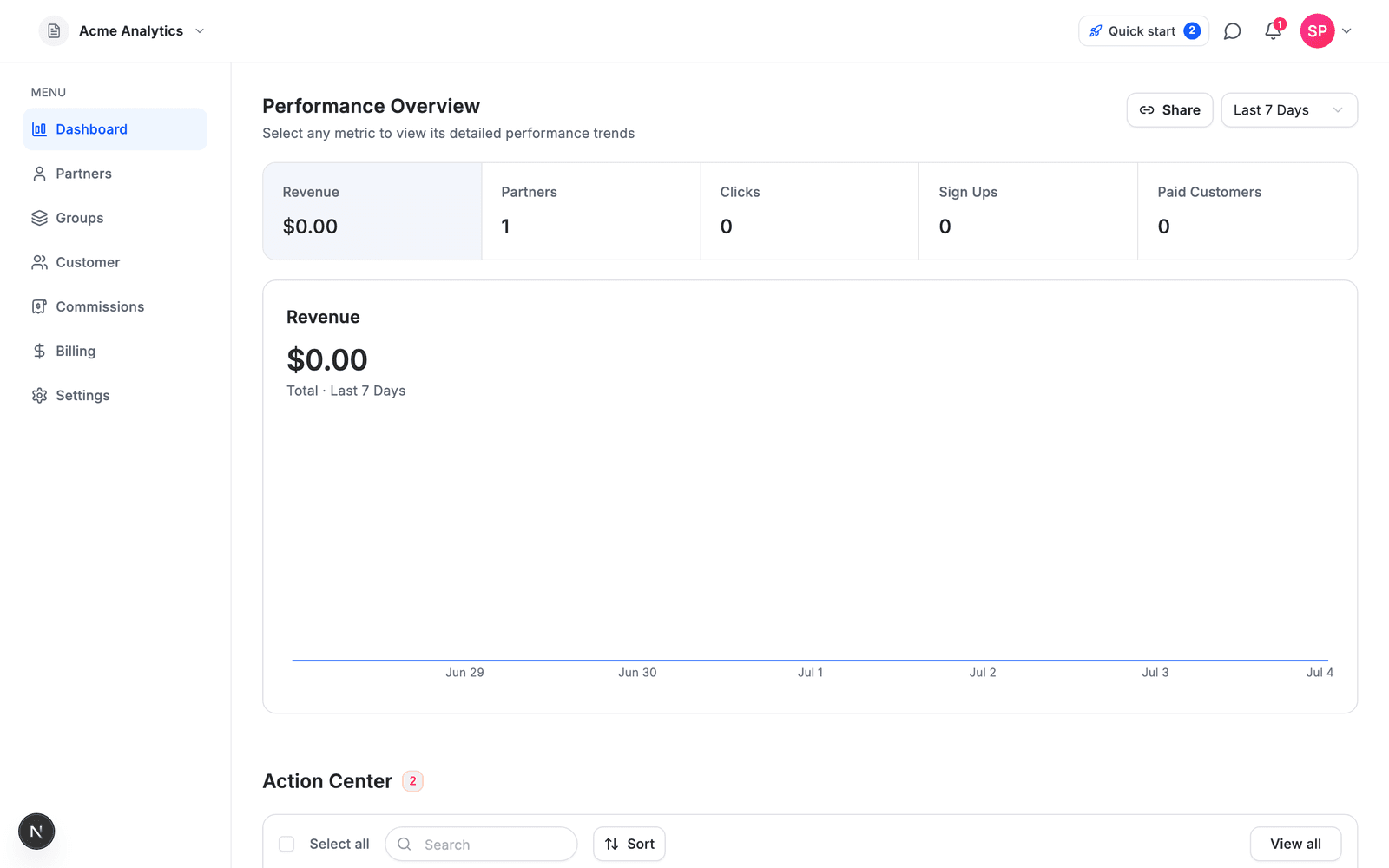
Affitor is our product, so here is the model stated plainly: you pay nothing until your affiliate program actually pays you.
Key features
Attribution is the architectural difference, not the pricing. Instead of a tracking cookie, Affitor anchors attribution to the signup: the click ID is joined to a hashed email at signup and then to the Stripe customer ID, riding Stripe Checkout metadata (affitor_click_id, affitor_customer_key) through to the sale. A cleared cookie after signup does not lose the referral, because the identity chain no longer depends on the cookie.
The agent surface is live today, not a roadmap item: a skill.md runbook an agent can complete end to end, the affitor CLI, browser and server SDKs plus an MCP server (@affitor/sdk and @affitor/mcp, both labeled beta), and a self-verify loop that fires a synthetic click, lead, and sale through your live integration and returns integration_verified: true when the chain holds. You (or your agent) get proof the integration works before a single real affiliate joins. The full setup path is walked in How to create a Stripe affiliate program.
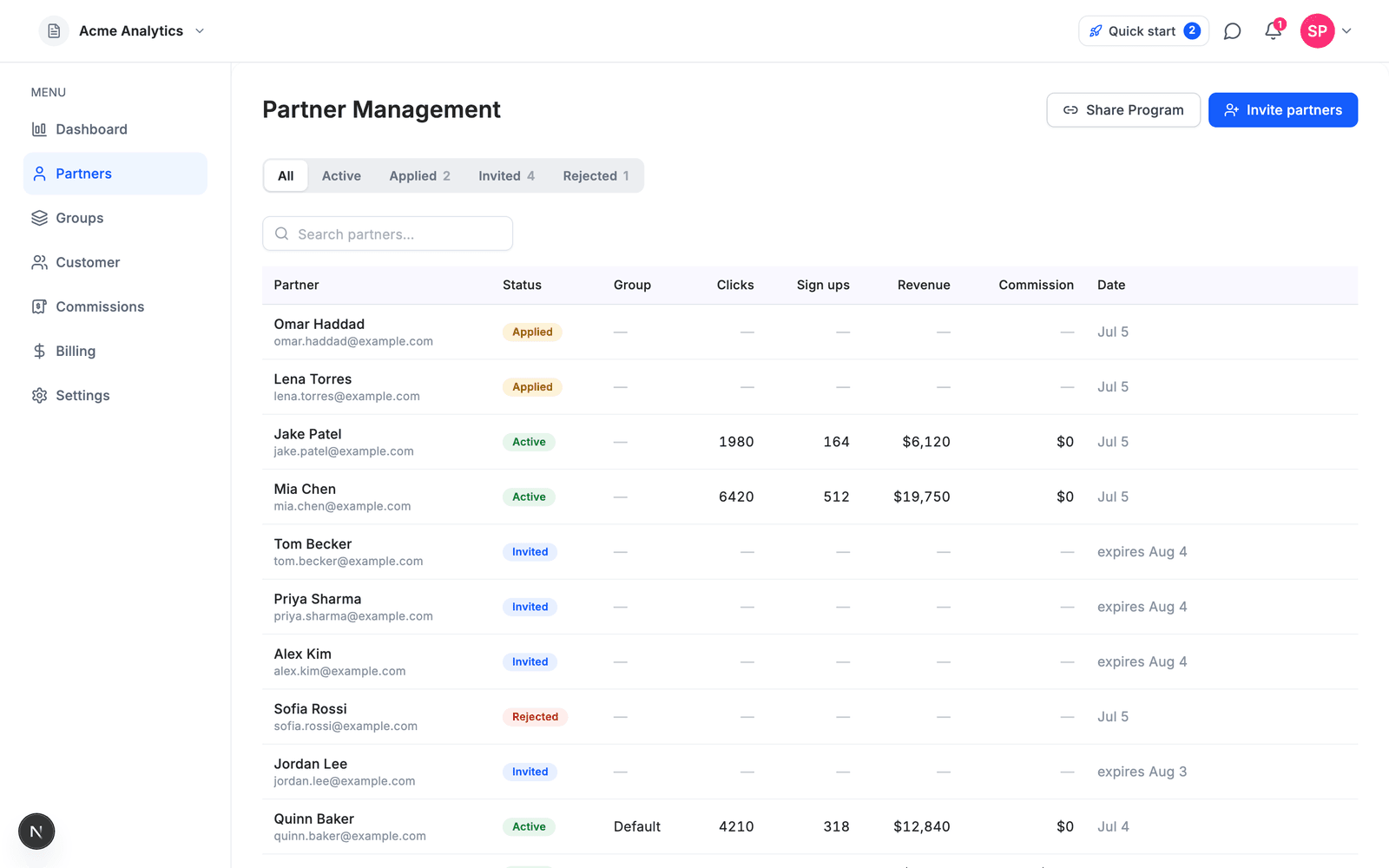
Day-to-day operations stay deliberately small: one flat partner table holds active partners, applications, and pending invites, and partner invites are pre-written from your program's real terms (commission rate, attribution window, payout threshold) — paste emails or import a CSV and send.
Pricing
$0/mo, $0 setup, and a 3.5% platform fee on affiliate-driven sales only. The fee is $0 until your program earns its first $10,000 through affiliates, then 3.5%. If your affiliates generate nothing, you pay nothing. There are no tiers and no revenue caps.
Pros & cons
Pros: no subscription and no caps, so cost scales with results; attribution survives cookie loss and device switches; the only tool in this comparison an agent can integrate and verify end to end.
Cons: a percentage fee means Affitor gets more expensive than a flat subscription as your program scales. At $15,000/mo in affiliate revenue, 3.5% is $525/mo while Rewardful's Growth plan is $99/mo. The crossover sits between roughly $1,400/mo and $2,800/mo in affiliate-driven revenue, depending on which Rewardful tier your volume would require. Below that (and before your first $10,000 total, when Affitor is free), the performance model wins; above it, a flat subscription is cheaper on paper, if you stay within its caps. Run your own numbers before choosing. Affitor is also Stripe-native — if you bill elsewhere, FirstPromoter covers more rails — and Rewardful has the strongest brand recognition among indie hackers, a history Affitor does not have yet.
Rewardful: $49 to $149+/mo from day one, 0% transaction fee, cookie attribution. Affitor: $0/mo, 3.5% on affiliate-driven sales after the first $10,000, signup-anchored attribution.
2. FirstPromoter — best for billing providers beyond Stripe
FirstPromoter is the most feature-complete of the sub-$100 tools, and the practical answer when your billing stack rules Rewardful out.
Key features
MRR-based commissions, tax form handling, fraud detection, and billing-provider coverage beyond Stripe and Paddle (Chargebee and others). Personalized affiliate dashboards and a custom domain arrive on the Business tier. If you bill through a provider Rewardful does not support, FirstPromoter is often the shortest path.
Pricing
Per firstpromoter.com/pricing (as of July 5, 2026): Starter is $49/mo for up to $5,000/mo in affiliate revenue, 3 campaigns, 1,000 affiliates, and no API. Business is $99/mo for up to $15,000/mo with unlimited campaigns and affiliates, API and webhooks, and tax forms. Enterprise starts at $149/mo. 14-day trial, no card required. No transaction fee is stated on the pricing page.
Pros & cons
Pros: the deepest back office at this price — MRR-shaped commissions, tax forms, fraud detection; five billing providers; three campaigns on the entry tier where Rewardful allows one.
Cons: the $5,000/mo cap on Starter is the lowest in this peer group, so upgrade pressure arrives earliest here. The API and webhooks are paywalled to the $99 tier: the entry plan is dashboard-only, which rules out programmatic and agent-driven setups at $49. Tracking is a cookie-window model on the front end (_fprom_* cookies, 60-day default); conversions are recorded at signup, but identity does not ride Stripe metadata natively. For the full head-to-head with Rewardful, see Rewardful vs FirstPromoter.
FirstPromoter: API and webhooks from the $99 Business tier up. Affitor: API, CLI, and MCP access at $0/mo on every program.
3. Tolt — best for unlimited affiliates on a flat fee
Tolt is the cleanest modern product in the Rewardful mold, and it removes the affiliate-count anxiety entirely.
Key features
Unlimited affiliates and referrals on every tier. Payout rails are the broadest here: PayPal, Wise, local bank transfer, crypto, and wire, with automatic payouts from the Growth tier up. At $99/mo Tolt gives you more revenue headroom than Rewardful's $99 tier ($20,000 vs $15,000 cap), a genuine edge at that price point.
Pricing
Per tolt.com/pricing (as of July 5, 2026): Basic is $69/mo for up to $10,000/mo in affiliate revenue with 2 programs and manual payouts only. Growth is $99/mo for up to $20,000/mo with 5 programs and automated payouts. Pro is $199/mo for up to $50,000/mo with unlimited programs. 14-day trial, no card required, 30-day refund. Note that software directories still show a stale $49 Basic price; the live page says $69.
Pros & cons
Pros: unlimited affiliates everywhere, wide payout rails, and the best revenue-headroom-per-dollar of the flat-fee trio at $99.
Cons: the nuance sits in the payout fees. Tolt markets 0% transaction fees, and that claim has a footnote: automated payouts carry a 2% processing fee, and the Basic tier avoids the fee only because its payouts are manual. Attribution is cookie-based click tracking with a configurable window, the same fragility as Rewardful's. No API is surfaced on the pricing page, and no official MCP was found as of June 2026.
Tolt: $69 to $199/mo, plus 2% on automated payouts. Affitor: $0/mo, one 3.5% fee on affiliate-driven sales after the first $10,000.
4. Dub Partners — best for developer-first teams
Dub has the best developer experience in this list, and it is not close.
Key features
SDKs in five languages, real-time webhooks, and docs built for programmatic use. Credit where due on architecture too: Dub's attribution is anchored to the signup lead rather than to a cookie window, which makes it the closest system to Affitor's model here. If you already run Dub for link infrastructure, adding Partners keeps links, analytics, and payouts in one platform.
Pricing
Per dub.co/pricing (as of July 5, 2026): Partners requires a paid plan. Business is $90/mo with partner payouts up to $2,500/mo at a 5% payout fee. Advanced is $300/mo with payouts up to $15,000/mo, also at 5%. Enterprise is custom, annual, with a 3% fee. These numbers are fresh: between June and July 2026, Business went from $75 to $90, Advanced from $250 to $300, and the Advanced payout fee from 3% to 5%.
Pros & cons
Pros: best-in-class SDKs and webhooks, signup/lead-anchored attribution, and one platform for links, analytics, and payouts.
Cons: the toll structure. You pay the subscription and a 5% fee on every partner payout, and the payout caps meter your program's growth by tier: a Business-plan program cannot pay partners more than $2,500 in a month. Attribution records live inside Dub's network, with no third-party-verifiable record; the only MCP found in June 2026 was community-built and static-key, with no self-verify loop.
Dub Partners: $90/mo plus a 5% fee on partner payouts, capped by tier. Affitor: $0/mo plus 3.5% on affiliate-driven sales after the first $10,000, no payout caps.
5. PartnerStack — best for enterprise partner programs
PartnerStack is not really a Rewardful substitute; it is a different category, priced like one.
Key features
A full partner-relationship-management suite: a B2B partner marketplace, lead and deal registration, MDF management, and partner training (LMS). If you run affiliates, resellers, and referral partners as one program at scale, it is the serious option on this page.
Pricing
PartnerStack published pricing in mid-2026 after years of sales-gated quotes. Per partnerstack.com/pricing (as of July 5, 2026): Launch starts at $1,000/mo paid annually, Growth at $1,520/mo paid annually, Enterprise is custom. That is a minimum commitment of roughly $12,000 per year, demo-led, with no self-serve signup.
Pros & cons
Pros: marketplace distribution, multi-type partner motions, and enterprise operations no point tool on this page attempts.
Cons: the price and the process. Attribution mechanics are not publicly documented, so we make no claims about them either way. For an early or mid-stage SaaS replacing a $49 tool, this is the wrong aisle; for a partnerships team that has outgrown affiliate-only motion, it is the right one. If PartnerStack's price is the reason you are here, the dedicated PartnerStack alternatives guide goes deeper.
PartnerStack: from $1,000/mo billed annually, demo first, full PRM suite. Affitor: self-serve signup, $0/mo, affiliate programs only.
Which one should you pick?
The honest segmentation is by stage, because the pricing models flip in value as affiliate revenue grows.
$0–500K ARR: pick Affitor, or Rewardful if you want a known flat cost. At this stage your affiliate program earns little or nothing yet, and a $49–$90 subscription is pure downside risk. Affitor is free until affiliates have generated $10,000, so the software decision needs no budget. If you would rather pay a predictable $49/mo for the category's most familiar tool, Rewardful is the default.
$500K–5M ARR: run the crossover math. If affiliate-driven revenue is consistently above roughly $1,400–$2,800/mo, a flat plan gets cheaper than a percentage: Rewardful Growth at $99/mo covers up to $15,000/mo, and Tolt's $99 tier covers $20,000/mo with unlimited affiliates. If you bill through Chargebee, Recurly, or Braintree, FirstPromoter's Business tier at $99/mo is the shortlist of one. If affiliate revenue is still lumpy, Affitor's pay-on-results model keeps quiet months free.
$5M+ ARR: think in programs, not trackers. If you run affiliates plus resellers plus referral partners with a partner manager, PartnerStack's PRM suite is the real option. If it is still a pure affiliate motion, the Enterprise tiers of Rewardful ($149+/mo) or FirstPromoter (from $149/mo) — or Dub's custom Enterprise with its 3% payout fee — cover the volume.
Every alternative at a glance
All prices verified against each vendor's live pricing page on July 5, 2026. Two vendors materially changed their pricing pages in the three weeks before publication. Check the live page before you commit.
| Platform | Monthly price | Fees on top | Caps | Attribution | API and agent surface |
|---|---|---|---|---|---|
| Affitor | $0 | 3.5% on affiliate-driven sales after first $10K | None | Signup-anchored, rides Stripe metadata | API, CLI, MCP, agent self-verify loop |
| Rewardful | $49 / $99 / $149+ | 0% | $7.5K / $15K per mo affiliate revenue | Cookie, 60-day default | REST API on all tiers |
| FirstPromoter | $49 / $99 / $149+ | None stated | $5K / $15K per mo affiliate revenue | Cookie window, 60-day default | API and webhooks at $99+ |
| Tolt | $69 / $99 / $199 | 2% on automated payouts | $10K / $20K / $50K per mo affiliate revenue | Cookie, configurable window | No API listed on pricing page |
| Dub Partners | $90 / $300 / custom | 5% payout fee (3% Enterprise) | Payouts $2.5K / $15K per mo | Signup/lead-anchored | Strong API and SDKs |
| PartnerStack | From $1,000 (annual) | None listed | Not published | Not publicly documented | Sales-led onboarding |
No official MCP server was found for any of the five competitors as of the June 2026 audit.
FAQ
What is the best Rewardful alternative for SaaS?
Affitor is the best Rewardful alternative for SaaS that wants to pay $0/month until affiliates generate their first $10,000 in revenue. FirstPromoter is the strongest pick when you bill outside Stripe and Paddle, and Tolt when you want unlimited affiliates on a flat subscription.
Is Affitor cheaper than Rewardful?
Affitor is cheaper than Rewardful until your program does roughly $1,400–$2,800/month in affiliate-driven revenue, and it is free until your first $10,000 total. Above the crossover, Rewardful's flat $49–$149+/month tiers (as of July 2026) are cheaper on paper, if you stay within their revenue caps.
Does Rewardful charge transaction fees?
No. Rewardful states a 0% transaction fee on every tier — the flat subscription ($49, $99, or $149+/month as of July 2026) is all you pay. The trade-off is revenue-capped tiers: $7,500/month in affiliate revenue on Starter and $15,000/month on Growth.
Which affiliate software has no monthly fee?
Affitor is the only tool in this comparison with no monthly fee: $0/month, with a 3.5% platform fee on affiliate-driven sales that starts only after your first $10,000 in affiliate revenue. Every competitor has a subscription floor — Rewardful $49, FirstPromoter $49, Tolt $69, Dub Partners $90, PartnerStack from $1,000/month paid annually (all as of July 5, 2026).
How much does affiliate tracking software cost in 2026?
Entry-tier pricing as of July 5, 2026: Rewardful and FirstPromoter $49/month, Tolt $69/month, Dub Partners $90/month plus a 5% payout fee, PartnerStack from $1,000/month paid annually, and Affitor $0/month plus 3.5% on affiliate-driven sales after the first $10,000. Prices in this category drift fast — two vendors changed their pricing pages in the three weeks before this was written.
Why do SaaS teams leave Rewardful?
Three reasons: revenue-capped tiers that force plan upgrades as affiliate sales grow, cookie-based attribution (60-day default) that silently drops conversions when cookies are cleared or devices switch, and a feature ceiling around multi-tier commissions, reporting, and fraud protection.
What's next
The short version: stay on Rewardful if its caps and cookie model do not hurt you yet. Pick FirstPromoter for billing providers beyond Stripe and Paddle or for tax forms. Pick Tolt for unlimited affiliates and broad payout rails at a flat price. Pick Dub Partners if you already live in Dub's link infrastructure and accept the payout fee. Pick PartnerStack when you are running a multi-type partner program with an enterprise budget. Pick Affitor if you want to pay only when your affiliates actually generate revenue, keep attribution alive after the cookie dies, or hand the whole integration to an agent and get back proof it works.
If the performance model fits your stage, create your program. It costs nothing to run until your affiliates have generated $10,000, so the way to evaluate Affitor is to launch with it.
If you want to see how signup-anchored tracking works before you decide, read the tracking docs. The click, signup, and sale chain is documented end to end, including the verification call that proves your integration is live.