
Comparison
Best PartnerStack Alternatives in 2026 (5 Tools Compared)
PartnerStack now publishes its pricing: from $1,000 per month, paid annually. Here is what that buys, who should genuinely pay it, and five self-serve alternatives with pricing verified in July 2026.
Updated Jul 5, 2026
PartnerStack starts at $1,000 per month, paid annually. That is roughly $12,000 committed for year one, agreed in a sales call, before your first partner sends a single click. If you run a multi-type partner program at scale, that price can be fair. If you are an early-stage SaaS founder who wants an affiliate program running this quarter, it is probably the wrong tool, and this page exists to help you pick the right one.
One disclosure before anything else: we build Affitor, one of the alternatives below. To keep this useful anyway, every price on this page comes from the vendor's own live pricing page, fetched on July 5, 2026, with a link so you can check it yourself. And we start by telling you when PartnerStack is the better choice.
Quick answer: what is the best PartnerStack alternative?
Affitor is the best PartnerStack alternative for an early-stage SaaS: it is self-serve and costs $0/month until affiliates generate your first $10,000 in revenue, versus PartnerStack's roughly $12,000/year minimum commitment. Rewardful is the best flat-fee pick for Stripe SaaS, FirstPromoter covers the most billing providers, Tolt gives you unlimited affiliates on every tier, and Dub Partners suits developer-led teams. Keep PartnerStack on the table only if you run affiliates, resellers, and referral partners as one program with a partner manager.
| Tool | Best for | From price (as of Jul 2026) | Transaction fee | Attribution |
|---|---|---|---|---|
| Affitor | Starting from zero on Stripe | $0/mo | 3.5% on affiliate-driven sales after first $10K | Signup-anchored via Stripe metadata |
| Rewardful | The known flat-fee default | $49/mo | 0% | Cookie, 60-day default |
| FirstPromoter | Billing beyond Stripe and Paddle | $49/mo | None stated | Cookie, 60-day default |
| Tolt | Unlimited affiliates on a flat fee | $69/mo | 2% on automated payouts | Cookie, configurable window |
| Dub Partners | Developer-led teams | $90/mo | 5% payout fee (3% Enterprise) | Signup/lead-anchored |
| PartnerStack | Enterprise multi-type programs | From $1,000/mo (paid annually) | None published | Not publicly documented |
Every price on this page was checked against each vendor's live pricing page on July 5, 2026.
What PartnerStack actually is
Most "PartnerStack alternatives" pages skip this part, and it produces bad decisions. PartnerStack is not an affiliate link tracker with a high price. It is a full partner relationship management (PRM) platform, and the extra money buys a genuinely different category of product:
- A partner marketplace. PartnerStack's homepage advertises a network of 115,000+ partners who can discover and join your program. No tool in the self-serve list below has distribution like that.
- Multi-type partner programs. Affiliate link tracking, plus lead and deal registration for referral and reseller motions. The Growth tier adds a training LMS, partner challenges, and MDF (market development funds) management.
- Enterprise operations. Partner payments at scale, compliance handling, CRM integrations, and on the Enterprise tier a designated customer success manager and custom workflows.
If you compare that to a $49 affiliate tracker on price alone, you are comparing categories, not products. The real question is whether you need a PRM at all.
The cost math
PartnerStack: per its pricing page as of July 5, 2026, the Launch tier starts at $1,000 per month, paid annually. The Growth tier starts at $1,520 per month, also paid annually. Enterprise is custom. That makes the minimum realistic commitment about $12,000 for year one, and about $18,240 if you need Growth-tier features. There is no self-serve signup and no free trial stated on the page; you book a demo, negotiate, and sign.
The self-serve field: every alternative below runs month to month, between $0 and $90 at the entry tier, and you can cancel any time.
Two honest notes on PartnerStack's numbers. First, publishing prices at all is new: until mid-2026 the pricing was fully sales-gated, so most older comparison articles are guessing. Second, you will find third-party reports claiming PartnerStack takes an additional percentage cut of partner payouts. We could not verify those claims against any official source, and the published pricing page lists subscription tiers only, so we are not repeating them. Judge it on the published numbers.
When PartnerStack is the right call
Recommending against a product for everyone is a sales pitch, not a comparison. PartnerStack is genuinely the right choice when:
- You run more than one partner motion: affiliates plus referral partners plus resellers, with deal registration feeding a sales team.
- You want marketplace distribution, recruiting from B2B partners already active on the network instead of building your recruiting pipeline from zero.
- You need program operations at scale: partner training, MDF budgets, compliance, and payments across a large partner base.
- You have (or are hiring) a partner manager whose job this platform is.
If that describes you, book the demo and negotiate. Nothing below replaces a full PRM, and pretending a $49 tracker covers deal registration would be a strawman.
What early-stage SaaS needs instead
If you were priced out rather than sold short, the checklist flips. Judge alternatives on four things:
- Self-serve signup. You should be live this week, not after a contract cycle. Everything below has self-serve signup; PartnerStack does not.
- Pricing shaped like performance. Early programs earn $0 in month one. Your cost should scale with affiliate revenue, not start as a five-figure annual commitment.
- Tracking that fits your billing stack. If you charge customers through Stripe, attribution should live where the money is, not in a cookie that dies before the trial converts.
- A surface you can verify. An API at minimum. Ideally a way for you, or an AI agent working for you, to prove the integration works end to end before a real dollar moves.
PartnerStack: demo, contract, annual invoice, then onboarding. The five below: sign up, install, first tracked link the same day.
1. Affitor — best for starting from zero on Stripe
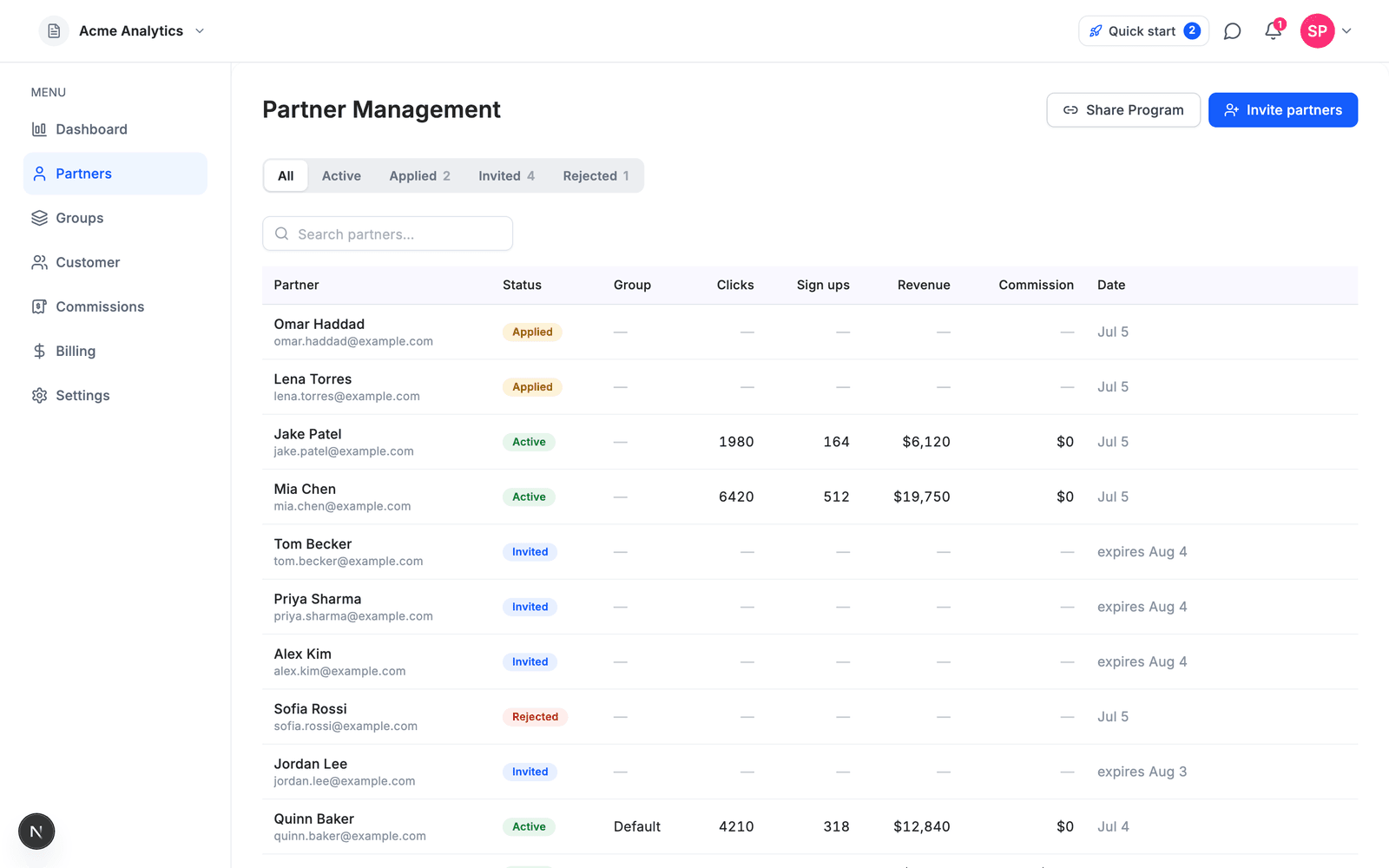
The performance-priced option: your cost is $0 until the program produces, then a single percentage of what it produces.
Key features
- Stripe-native attribution. Tracking rides Stripe metadata on the Checkout Session, anchored to an identity chain created at signup (click, hashed email, Stripe customer). It survives cleared cookies because the durable record is the signup, not the cookie.
- Built for agents as well as humans, shipped today.
npx affitor onboarddetects your stack, installs tracking, and verifies it. The verification is a synthetic click, lead, and sale chain that ends inintegration_verified: true, so you know attribution works before launch. As of the June 2026 audit, no other platform on this page shipped an official MCP server or an agent-completable integration runbook with that kind of self-verify loop. - Partner operations without a partner manager. One flat partner table shows active partners, applications, and pending invites in a single view, and partner invites are pre-written from your program's real terms (commission rate, attribution window, payout threshold) — type emails or import a CSV and send.
Pricing
$0 per month, $0 setup. The platform fee is $0 until your program earns its first $10,000 through affiliates, then 3.5% on affiliate-driven sales only. Details are on the pricing model page. Against PartnerStack the contrast is simple: PartnerStack wants about $12,000 committed before your first affiliate sale; Affitor charges nothing until affiliates have brought you $10,000.
Pros & cons
Pros: zero fixed cost, no revenue caps, attribution that survives cookie loss, and an integration an agent can complete and prove.
Cons: Affitor is an affiliate layer, not a PRM. There is no deal registration, no LMS, no MDF management; if you need those, you are back in PartnerStack territory. It is built around Stripe, so if your billing runs elsewhere, FirstPromoter's broader billing coverage fits better. And the percentage model has a crossover point, so run the math for your scale: after the free $10,000, a program doing $3,000 per month in affiliate revenue pays about $105 to Affitor, already in flat-plan territory, and at $15,000 per month it pays $525 while Rewardful's $99 Growth tier still covers that revenue. The model is built to favor programs starting from zero; once affiliate revenue is consistently strong, a capped flat plan can be cheaper.
Fits: Stripe-based SaaS starting an affiliate program from zero, and teams that want an integration an agent can complete and prove.
2. Rewardful — best flat-fee default for Stripe SaaS
The category's most recognized name, and the simplest setup for a Stripe SaaS.
Key features
The simplest setup in the category for Stripe SaaS, the strongest brand recognition among indie hackers, a genuine 0% transaction fee, and a REST API included even on the $49 plan.
Pricing
Per rewardful.com/pricing as of July 5, 2026: Starter at $49/mo (up to $7,500/mo in affiliate revenue, 1 campaign, up to 2 team members), Growth at $99/mo (up to $15,000/mo, unlimited campaigns and team, branded portal), Enterprise at $149+/mo (over $15,000/mo, 1-click PayPal payouts). 0% transaction fee on every tier, a 14-day free trial, and 2 months free on annual billing. PartnerStack: $12,000 for year one. Rewardful: $588 for a year of Starter, cancelable monthly.
Pros & cons
Pros: known quantity, fast setup, API from the first dollar, and a stated 0% transaction fee.
Cons: it connects to Stripe and Paddle only. Attribution is cookie-based (first-touch or last-touch selectable, 60-day default window), which is fragile when cookies are cleared or the buyer switches devices. The revenue-capped tiers mean success forces upgrades, and you pay $49 from day one whether or not affiliates deliver. If you are weighing it against its closest rival, read Rewardful vs FirstPromoter; if you are weighing it against everything, read the best Rewardful alternatives.
Fits: Stripe or Paddle SaaS that wants the known, simple option and is comfortable with cookie-window attribution.
3. FirstPromoter — best for billing beyond Stripe and Paddle
The broadest billing coverage in the set, with the deepest back office under $100.
Key features
Native integrations with five billing providers (Stripe, Paddle, Recurly, Chargebee, Braintree), MRR-based commissions, tax form handling, and fraud detection. If your billing is not Stripe, this is the strongest flat-fee option here.
Pricing
Per firstpromoter.com/pricing as of July 5, 2026: Starter at $49/mo (up to $5,000/mo in affiliate revenue, 3 campaigns, 1,000 affiliates, no API), Business at $99/mo (up to $15,000/mo, unlimited campaigns and affiliates, API and webhooks, tax forms), Enterprise starting at $149/mo. 14-day trial, no card required. PartnerStack: five billing figures deep before you see a dashboard. FirstPromoter: $588 a year at the floor.
Pros & cons
Pros: five billing rails, MRR-shaped commissions, tax paperwork handled inside the product.
Cons: the $49 tier is dashboard-only; the API and webhooks are paywalled to $99 and up. Its $5,000/mo revenue cap is the lowest in this set, so upgrade pressure hits earliest. The front end is cookie-window tracking (_fprom_* cookies, 60-day default), and no official MCP was found as of June 2026.
Fits: SaaS on Paddle, Chargebee, Recurly, or Braintree, and teams that want MRR-shaped commissions with tax paperwork handled.
4. Tolt — best for unlimited affiliates
The modern flat-fee pick that removes affiliate-count limits entirely.
Key features
Unlimited affiliates and referrals on every tier, more revenue headroom per dollar at $99 than Rewardful or FirstPromoter ($20K cap vs $15K), and wide payout rails: PayPal, Wise, local bank transfer, crypto, and wire, with automatic payouts from Growth up.
Pricing
Per tolt.com/pricing as of July 5, 2026: Basic at $69/mo (up to $10,000/mo in affiliate revenue, 2 programs, manual payouts only), Growth at $99/mo (up to $20,000/mo, 5 programs, auto payouts with a 2% processing fee), Pro at $199/mo (up to $50,000/mo), Enterprise custom above that. 14-day trial, no card required, 30-day refund. Note: aggregator sites still show a stale $49 Basic price; the live page says $69. PartnerStack: annual contract. Tolt: $828 a year at the floor, monthly terms.
Pros & cons
Pros: no affiliate limits anywhere, global payout options, best headroom-per-dollar at the $99 tier.
Cons: the $69 floor is the highest of the flat-fee trio, and the "0% transaction fees" marketing carries a nuance: automatic payouts have a 2% processing fee, and the Basic tier avoids it only by making all payouts manual. Attribution is cookie-based click tracking. No API is surfaced on the pricing page, and no official MCP was found as of June 2026.
Fits: SaaS on Stripe, Paddle, or Chargebee that expects a large affiliate base early and wants global payout options.
5. Dub Partners — best for developer-led teams
Affiliate infrastructure priced and shaped like developer tooling.
Key features
The developer experience: SDKs in five languages, real-time webhooks, and agent-friendly documentation. Credit where due on tracking, too: Dub's attribution is lead/signup-anchored (the click is captured server-side and the durable record is the signup), which is architecturally the closest to Affitor's approach in this list. And you get link infrastructure, analytics, and partner payouts in one platform.
Pricing
Per dub.co/pricing as of July 5, 2026: Business at $90/mo (10K new links/mo, 250K tracked events, up to $2,500/mo in partner payouts at a 5% payout fee, 10 users), Advanced at $300/mo (50K links, 1M events, $15,000/mo in payouts at 5%), Enterprise custom on annual terms (payouts at 3%, SSO/SAML). Partners requires a paid plan. These numbers moved recently: between mid-June and early July 2026, Business went from $75 to $90, Advanced from $250 to $300, and the Advanced payout fee from 3% to 5%. Re-check the live page. PartnerStack: one big toll. Dub: two smaller ones, subscription plus a payout fee.
Pros & cons
Pros: best-in-class SDKs and webhooks, signup/lead-anchored attribution, links + analytics + payouts in one product.
Cons: you pay twice: a $90/mo floor plus 5% of every partner payout (3% only on custom Enterprise). Payout caps meter your growth: $2,500/mo on Business means a successful program hits the ceiling fast. And attribution lives inside Dub's closed network; the only MCP found as of June 2026 was community-built and static-key, with no agent self-verify loop.
Fits: developer-led teams already using Dub for links, with budget for the subscription plus the payout fee.
Which one should you pick?
$0–500K ARR: Affitor, or Rewardful for a known flat cost. A five-figure annual PRM contract at this stage is a category error. Affitor costs $0 until affiliates have generated $10,000; Rewardful is the familiar $49/mo default if you prefer a fixed bill.
$500K–5M ARR: pick by billing stack and volume. On Stripe with steady affiliate revenue above roughly $1,400–$2,800/mo, a capped flat plan gets cheaper: Rewardful Growth or Tolt Growth at $99/mo. Off Stripe, FirstPromoter's five billing rails decide it. Developer-led teams already on Dub can justify the double toll for the tooling.
$5M+ ARR with multiple partner motions: PartnerStack. This is the stage its pricing assumes: a partner manager on payroll, resellers and referral partners alongside affiliates, and marketplace distribution worth paying for. Book the demo with the checklist from this page in hand.
Every option at a glance
All figures from each vendor's live pricing page, July 5, 2026.
| Platform | Monthly floor | Fees on top | Caps to watch | Self-serve? |
|---|---|---|---|---|
| PartnerStack | From $1,000 (paid annually) | None published | Not published | No, demo-led |
| Affitor | $0 | 3.5% on affiliate-driven sales, after your first $10,000 fee-free | None | Yes |
| Rewardful | $49 | 0% transaction fee | $7,500/mo affiliate revenue on Starter | Yes |
| FirstPromoter | $49 | None stated | $5,000/mo on Starter; API from $99 | Yes |
| Tolt | $69 | 2% on auto payouts (Growth and up) | $10,000/mo on Basic; manual payouts only on Basic | Yes |
| Dub Partners | $90 | 5% payout fee (3% on Enterprise) | $2,500/mo payouts on Business | Yes |
Affiliate software pricing drifts fast. Two of the vendors above materially changed their pricing pages in the three weeks before this post was written, so treat every dollar figure as "as of July 5, 2026" and confirm against the linked pricing pages before you commit.
FAQ
How much does PartnerStack cost?
PartnerStack's Launch tier starts at $1,000 per month, paid annually, and its Growth tier at $1,520 per month, also paid annually (per its own pricing page as of July 5, 2026). That makes the minimum realistic commitment about $12,000 for year one, negotiated in a sales call — there is no self-serve signup.
What is the best PartnerStack alternative for SaaS?
Affitor is the best PartnerStack alternative for an early-stage SaaS: self-serve signup and $0/month until affiliates generate your first $10,000 in revenue, versus PartnerStack's roughly $12,000/year minimum commitment. If you genuinely run a multi-type partner program with a partner manager, PartnerStack itself may still be the right call.
Is there a free alternative to PartnerStack?
Affitor is the only tool in this comparison with no subscription: $0/month and $0 setup, with a 3.5% platform fee on affiliate-driven sales that begins only after your first $10,000 in affiliate revenue. Rewardful, FirstPromoter, Tolt, and Dub Partners all charge monthly floors of $49–$90 as of July 2026.
Does PartnerStack take a cut of partner payouts?
Its published pricing page lists subscription tiers only, and we could not verify third-party reports of an additional percentage cut against any official source. Judge PartnerStack on its published numbers: from $1,000/month paid annually as of July 5, 2026.
Which PartnerStack alternatives are self-serve?
All five alternatives on this page — Affitor, Rewardful, FirstPromoter, Tolt, and Dub Partners — have self-serve signup and month-to-month terms. PartnerStack is the only demo-led, annual-contract product in the set.
What's next
If PartnerStack's category is what you need, book their demo with the checklist from this page in hand. If you need an affiliate program without the commitment, create your program on Affitor: it costs $0 until your program earns its first $10,000 through affiliates, then 3.5%. Then read how Affitor tracking fits together to see the signup-anchored attribution model in detail before you install anything — and if you are starting a program from scratch, the six-step launch guide covers everything beyond the software choice.